Aerostar 700 for Sale
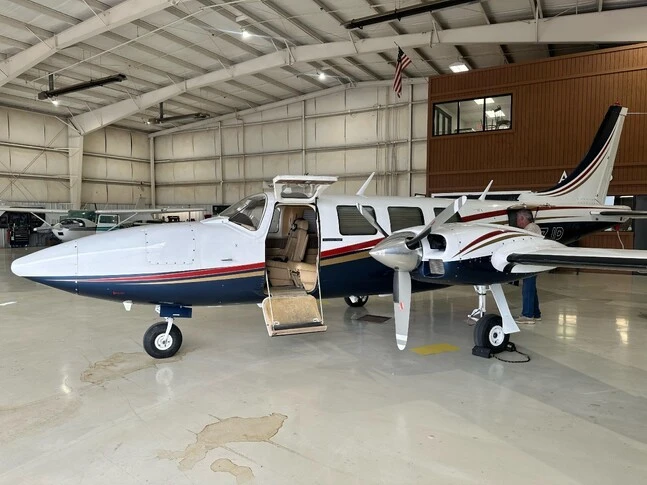
What a Aerostar 700 costs, how far it flies, and what it costs to keep
PlaneFox tracks 4 Aerostar 700 aircraft for sale and re-reads every one of them from the broker and dealer sites it watches, so the figures below move when the market moves. Every number on this page is measured from those live listings, not taken from a published price guide.
How far can a Aerostar 700 fly?
A Aerostar 700 flies about 1,100 nm, roughly 2,037 km, which is about 4 h 53 min in still air at typical cruise.
What does a Aerostar 700 cost to own?
A Aerostar 700 costs about EUR 10,091 a month to run, or about EUR 853 for every flight hour when it is flown 150 hours a year.
More questions about the Aerostar 700
How much does a Aerostar 700 cost?
What is the price range for a used Aerostar 700?
How many Aerostar 700 aircraft are for sale right now?
Where can I find a Aerostar 700 for sale?
What should I check when buying a used Aerostar 700?
About the Aerostar 700
Aircraft overview
The Aerostar 700 is the high powered, pressurized piston twin in the Ted Smith Aerostar family, certificated as the PA-60-700P after the design had passed through Piper ownership and back to Aerostar Aircraft Corporation. It appeared in the mid 1980s as a development of the earlier 600 and 601 series, retaining the compact, low drag Aerostar airframe while adding more power and higher certified weights. Its role is a fast owner flown or business transport for buyers who want cabin class twin performance without moving into turboprop operating economics.
Performance & specifications
Power comes from two turbocharged Lycoming TIO-540-U2A engines, each rated at 350 hp. The Aerostar 700 is known for cruise speeds in the mid 200 knot range when operated in the flight levels, with a certificated ceiling of 25,000 feet. Range depends strongly on power setting, fuel system, reserves and altitude, but typical trip planning is often around 1,000 nautical miles in long range cruise. Maximum takeoff weight is 6,315 lb, and useful load varies by individual aircraft, modifications and equipment, commonly placing payload and fuel planning at the center of any purchase evaluation.
Cabin & avionics
The Aerostar 700 normally seats six, with pilot and copilot positions up front and club style or forward facing passenger seating in the pressurized cabin. The cabin is not large by turboprop standards, but it is quiet and efficient for four adults with baggage on longer trips when weight and balance are managed carefully. Factory avionics were period analog systems, often Bendix/King or Collins. On the used market, many examples have been updated with Garmin GNS or GTN navigators, Garmin G500 or G600 displays, Aspen electronic flight instruments, modern audio panels, ADS-B and digital engine monitoring. Garmin Perspective and factory G1000 installations are not typical for this model.
Buying & value
Buyers should confirm that the aircraft is a true Aerostar 700 or PA-60-700P, not an earlier 601P or a conversion represented loosely as a 700. Records should document engine time, turbocharger condition, pressurization system health, fuel tank condition, landing gear maintenance, corrosion inspections and compliance with Aerostar specific service bulletins and airworthiness directives. Desirable upgrades include intercooling, modern engine monitoring, current IFR GPS, updated autopilot capability, known icing equipment where installed, and well documented maintenance by shops familiar with the type. In the used market, the Aerostar 700 occupies a specialized position: rarer and more powerful than most piston twins, faster than many cabin class contemporaries, but demanding of disciplined maintenance and experienced ownership.