FK-Lightplanes FK12 Comet for Sale

What a FK-Lightplanes FK12 Comet costs, how far it flies, and what it costs to keep
PlaneFox tracks 2 FK-Lightplanes FK12 Comet aircraft for sale and re-reads every one of them from the broker and dealer sites it watches, so the figures below move when the market moves. Every number on this page is measured from those live listings, not taken from a published price guide.
How far can a FK-Lightplanes FK12 Comet fly?
A FK-Lightplanes FK12 Comet flies about 351 nm, roughly 650 km, which is about 3 h 37 min in still air at typical cruise.
What does a FK-Lightplanes FK12 Comet cost to own?
A FK-Lightplanes FK12 Comet costs about EUR 926 a month to run, or about EUR 109 for every flight hour when it is flown 150 hours a year.
More questions about the FK-Lightplanes FK12 Comet
How much does a FK-Lightplanes FK12 Comet cost?
What is the price range for a used FK-Lightplanes FK12 Comet?
How many FK-Lightplanes FK12 Comet aircraft are for sale right now?
Where can I find a FK-Lightplanes FK12 Comet for sale?
What should I check when buying a used FK-Lightplanes FK12 Comet?
About the FK-Lightplanes FK12 Comet
Aircraft overview
The FK-Lightplanes FK12 Comet is a two-seat, tandem biplane designed by Peter Funk and produced by FK-Lightplanes in Germany from the late 1990s onward. It sits in the European ultralight and light-sport-style category, but its configuration is unusual: a compact, modern biplane with strut-braced wings, composite and metal construction, and sporty handling rather than a purely touring focus. The type is distinct from FK-Lightplanes’ high-wing FK9 and low-wing FK14 Polaris; the FK12 Comet is the company’s open-cockpit, vintage-inspired sport biplane.
Performance & specifications
Most FK-Lightplanes FK12 Comet aircraft are powered by Rotax 912-series engines, commonly the 80 hp Rotax 912 UL or 100 hp Rotax 912 ULS, with installation details depending on year and local certification rules. Typical cruise speeds are in the region of 80-95 knots, with economical operation and short-field capability being more relevant than high-speed cross-country performance. Depending on fuel fit, engine, propeller, and national weight category, range is commonly several hundred nautical miles rather than a long-distance touring figure. Many examples were built to European ultralight maximum takeoff weights around 450-472.5 kg, so useful load must be checked aircraft by aircraft. Service ceiling figures vary by engine and propeller installation, but the type is generally operated as a day-VFR recreational aircraft rather than a high-altitude traveller.
Cabin & avionics
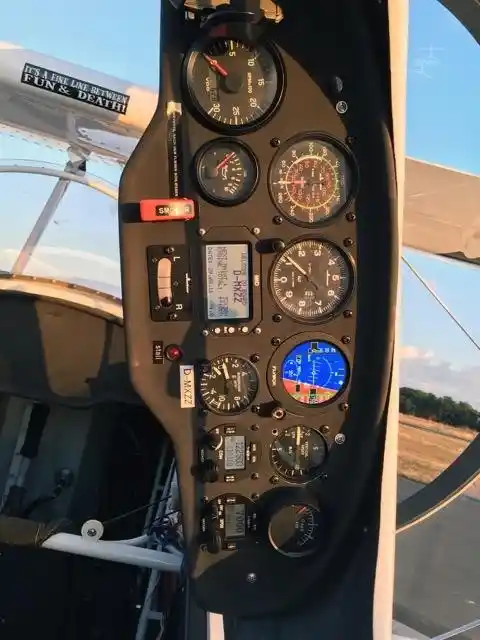
The FK-Lightplanes FK12 Comet has tandem seating, with the pilot and passenger seated one behind the other under individual windshields or, on some aircraft, canopy arrangements depending on build and equipment. The cockpit is narrow and sport-oriented, with good outside visibility and a more exposed flying experience than enclosed touring ultralights. Avionics are usually simple VFR installations: airspeed, altitude, engine monitoring, compass or GPS, and a VHF radio/transponder where required. Later or upgraded examples may have compact EFIS units from suppliers such as Dynon, MGL, or Garmin portable-panel equipment, but integrated suites such as Garmin Perspective or G1000 are not typical for this aircraft.
Buying & value
Used FK-Lightplanes FK12 Comet aircraft appeal to buyers wanting a distinctive recreational biplane with Rotax operating economics. Inspection should focus on airframe condition, wing attachment points, struts, control linkages, fabric or covering condition where applicable, landing gear, propeller, and evidence of ground loops or hard landings. Engine logbooks, gearbox service history, carburetor maintenance, and compliance with Rotax service bulletins are important. Buyers should verify the exact national certification category, permitted weights, and whether aerobatic or manoeuvre limitations apply to that individual aircraft. Common differences include engine choice, propeller type, instrument upgrades, cockpit covering, and ballistic parachute fit. In the used market, the FK-Lightplanes FK12 Comet is positioned as a niche sport aircraft rather than a utility trainer or fast tourer.