Fairchild Metro / Merlin for Sale

Fairchild Metro
Contact for Price
turboprop
1982 Fairchild Metroliner III SA 227 Heavy
Contact for Price
turboprop1995 SWEARINGEN SA227-DC
Contact for Price
San Marcos
turboprop1969 FAIRCHILD MERLIN IIB
Contact for Price
Bastrop
turboprop1988 SWEARINGEN SA-227AC METRO III
Contact for Price
Springfield (KSGF)
turboprop1972 SWEARINGEN SA226-T MERLIN III
Contact for Price
Mojave
turboprop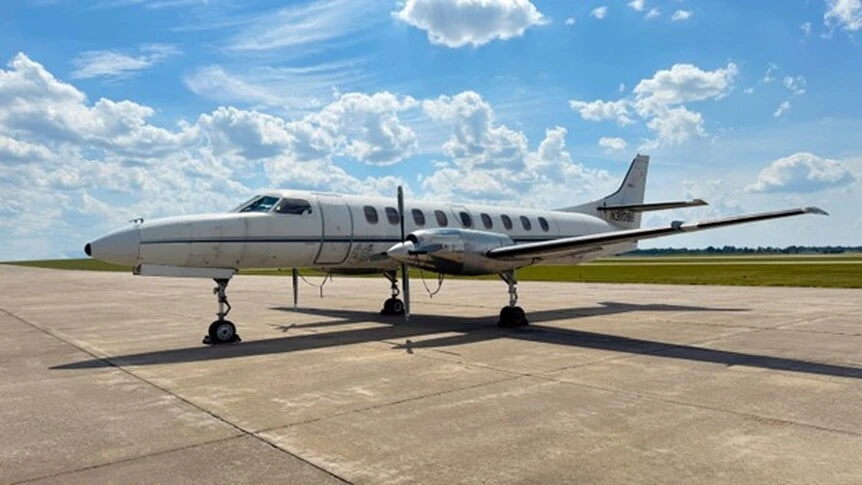
1982 SWEARINGEN SA-227AC METRO III
Contact for Price
Springfield (KSGF)
turbopropWhat a Fairchild Metro / Merlin costs, how far it flies, and what it costs to keep
PlaneFox tracks 7 Fairchild Metro / Merlin aircraft for sale and re-reads every one of them from the broker and dealer sites it watches, so the figures below move when the market moves. Every number on this page is measured from those live listings, not taken from a published price guide.
How far can a Fairchild Metro / Merlin fly?
A Fairchild Metro / Merlin flies about 1,938 nm, roughly 3,589 km, which is about 6 h 55 min in still air at typical cruise.
What does a Fairchild Metro / Merlin cost to own?
A Fairchild Metro / Merlin costs about EUR 29,630 a month to run, or about EUR 1,566 for every flight hour when it is flown 150 hours a year.
More questions about the Fairchild Metro / Merlin
How much does a Fairchild Metro / Merlin cost?
What is the price range for a used Fairchild Metro / Merlin?
How many Fairchild Metro / Merlin aircraft are for sale right now?
Where can I find a Fairchild Metro / Merlin for sale?
What should I check when buying a used Fairchild Metro / Merlin?
About the Fairchild Metro / Merlin
Aircraft overview
The Fairchild Metro / Merlin family traces its roots to Swearingen Aircraft, later Fairchild Swearingen and Fairchild Aircraft. The Merlin business turboprops preceded the commuter-focused Metro, with the SA226-TC Metro first flying in 1969 and production of Metro/Merlin derivatives continuing into the late 1990s. The Metro is best known as a pressurized 19-seat regional airliner and feeder-freight aircraft, while the Merlin variants serve the corporate and utility market with executive interiors. The type matters because it combined jet-like turboprop speed, a narrow but efficient cabin, and Garrett powerplants in a relatively economical airframe for short-haul commercial work.
Performance & specifications
Typical Fairchild Metro / Merlin performance depends strongly on variant, engine rating, and configuration. Metro III and Metro 23 aircraft commonly cruise in the high-200-knot range, with published maximum cruise speeds around 280-300 knots. Practical range is often around 1,000 nautical miles in airline layouts, with longer legs possible in some Merlin executive configurations. Service ceiling is typically up to 25,000 feet. Most aircraft use Garrett, later Honeywell, TPE331 series turboprops, commonly including TPE331-10, -11, or -12 variants on later Metros, driving three- or four-blade propellers depending on model and upgrade status.
Cabin & avionics
The Metro cabin is pressurized and usually arranged for 19 passengers in commuter service, with a slim fuselage, aisle access, and limited baggage compared with larger regional turboprops. Cargo Metros are widely used with stripped interiors and freight provisions. Merlin corporate versions typically seat about 6 to 9 passengers, depending on club seating, side-facing seats, refreshment cabinet, and lavatory installation. Avionics vary widely by age: many examples retain Collins, Bendix/King, or Sperry-era panels, while upgraded aircraft may have Garmin GNS or GTN navigators, modern transponders, ADS-B compliance, digital weather, and retrofit EFIS. Garmin G1000 or Garmin Perspective should not be assumed as standard equipment on this family.
Buying & value
Prospective buyers should separate airline Metro, cargo Metro, and Merlin executive aircraft carefully, as mission equipment and cabin condition drive value. Key review items include TPE331 engine times and hot-section status, propeller life, pressurization performance, landing gear cycles, corrosion, windshield and cabin window condition, de-ice equipment, and compliance with applicable airworthiness directives and structural inspections. Common variants include the SA226-TC Metro II, SA227-AC Metro III, SA227-CC Metro 23, and Merlin III/IIIB/IV derivatives. On the used market, the Fairchild Metro / Merlin typically positions as a fast, capable turboprop with attractive acquisition cost, offset by specialized maintenance knowledge, higher crew-training demands, and a narrower buyer pool than mainstream cabin-class turboprops.