Dassault Falcon 900 for Sale

2010 Dassault Falcon 900EX Easy
Contact for Price
Paris
jet
2006 Dassault Falcon 900EX EASy
Contact for Price
jet
1997 Dassault Falcon 900B
Contact for Price
TANGMERE
jet1993 DASSAULT FALCON 900B
$6,595,000
Chesterfield, Missouri
jet1999 DASSAULT FALCON 900EX
Contact for Price
Fort Ft. Lauderdale, Florida
jet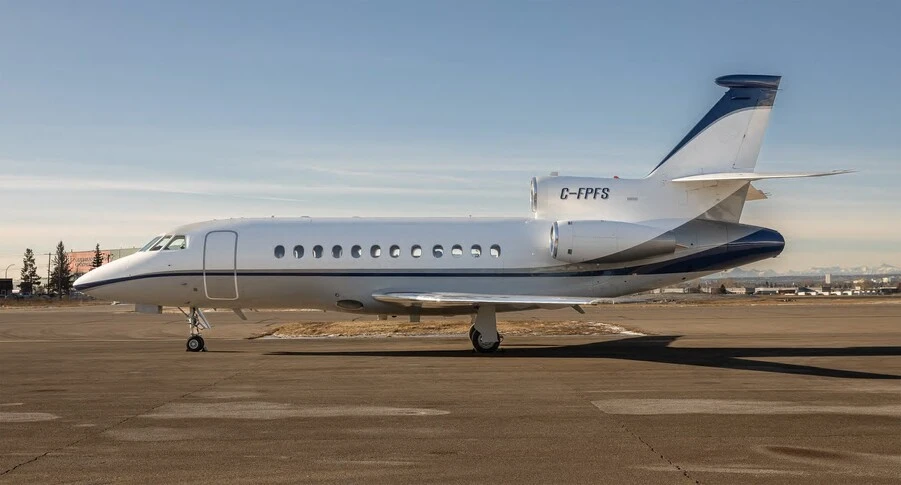
2001 DASSAULT FALCON 900EX
$15,950,000
North America + Canada, Canada
jet2003 DASSAULT FALCON 900C
$4,975,000
Cincinnati, Ohio
jet1994 DASSAULT FALCON 900
Contact for Price
Destrehan, Louisiana
jet1988 DASSAULT FALCON 900B
Contact for Price
Chicago, Illinois
jet2008 DASSAULT FALCON 900EX EASY
Contact for Price
Austin, Texas
jet1998 DASSAULT FALCON 900EX
$8,495,000
Buffalo (KBUF)
jetNot Listed DASSAULT FALCON 900EX
Contact for Price
USA
jet1988 DASSAULT FALCON 900B
Contact for Price
San Bernardino (KSBD)
jetWhat a Dassault Falcon 900 costs, how far it flies, and what it costs to keep
PlaneFox tracks 13 Dassault Falcon 900 aircraft for sale and re-reads every one of them from the broker and dealer sites it watches, so the figures below move when the market moves. Every number on this page is measured from those live listings, not taken from a published price guide.
How far can a Dassault Falcon 900 fly?
A Dassault Falcon 900 flies about 3,900 nm, roughly 7,223 km, which is about 8 h 8 min in still air at typical cruise.
What does a Dassault Falcon 900 cost to own?
A Dassault Falcon 900 costs about EUR 94,633 a month to run, or about EUR 4,259 for every flight hour when it is flown 150 hours a year.
More questions about the Dassault Falcon 900
How much does a Dassault Falcon 900 cost?
What is the price range for a used Dassault Falcon 900?
How many Dassault Falcon 900 aircraft are for sale right now?
Where can I find a Dassault Falcon 900 for sale?
What should I check when buying a used Dassault Falcon 900?
About the Dassault Falcon 900
Aircraft overview
The Dassault Falcon 900 is a French-built, large-cabin business jet produced by Dassault Aviation. The model first flew in 1984 and entered service in the mid-1980s, with the family continuing through later 900B, 900EX, 900C, 900DX and 900LX variants. It occupies the long-range business jet category and is known for its three-engine layout, a distinguishing feature among corporate aircraft of its size. The Dassault Falcon 900 matters to buyers because it combines intercontinental capability, strong short-field performance and a cabin sized for transoceanic corporate use, while remaining smaller than the Falcon 7X and Falcon 8X families.
Performance & specifications
Typical high-speed cruise is around Mach 0.84, with long-range cruise usually planned lower for maximum efficiency. Range depends strongly on variant, payload, reserves and configuration: earlier Falcon 900 and 900B aircraft are commonly associated with about 4,000 nautical miles, while the 900EX and later winglet-equipped 900LX extend this to roughly 4,500 to 4,750 nautical miles. Certified ceiling is 51,000 feet. The type is powered by three Honeywell, formerly Garrett, TFE731 turbofan engines, with later versions using more capable TFE731-60 series engines. Useful load and full-fuel payload vary by completion and equipment, so aircraft-specific weight and balance records are important in any comparison.
Cabin & avionics
The Falcon 900 typically seats 12 to 14 passengers, depending on layout, with a stand-up cabin, forward galley, enclosed lavatory and multiple seating zones suitable for work, dining and rest. Cabin dimensions and noise levels vary with refurbishment standard, insulation and interior age. Early aircraft were delivered with avionics such as Honeywell SPZ-8000 or Primus 2000 systems, while later 900EX EASy, 900DX and 900LX aircraft use Dassault’s EASy flight deck, based on Honeywell Primus Epic architecture. Many used examples have upgrades for FANS, CPDLC, ADS-B Out, WAAS or modern cabin connectivity.
Buying & value
For used-aircraft buyers, the main distinctions are variant, engine program status, avionics compliance, maintenance history, landing gear and major inspection timing, and the quality of any cabin or connectivity upgrades. The 900B often represents an older, lower-entry point, while the 900EX, 900EX EASy and 900LX command higher values for range, avionics and operating capability. Current PlaneFox listing data shows an average asking price of about EUR 7,540,000, with observed asking prices from EUR 4,290,000 to EUR 13,760,000. In the market, the Dassault Falcon 900 is generally positioned as a long-range, large-cabin trijet for buyers prioritizing runway flexibility, cabin volume and proven international capability.