What a Hawker Hurricane costs, how far it flies, and what it costs to keep
PlaneFox tracks 1 Hawker Hurricane aircraft for sale and re-reads every one of them from the broker and dealer sites it watches, so the figures below move when the market moves. Every number on this page is measured from those live listings, not taken from a published price guide.
How far can a Hawker Hurricane fly?
A Hawker Hurricane flies about 417 nm, roughly 772 km, which is about 1 h 46 min in still air at typical cruise.
More questions about the Hawker Hurricane
How much does a Hawker Hurricane cost?
What is the price range for a used Hawker Hurricane?
How many Hawker Hurricane aircraft are for sale right now?
Where can I find a Hawker Hurricane for sale?
What should I check when buying a used Hawker Hurricane?
About the Hawker Hurricane
Aircraft overview
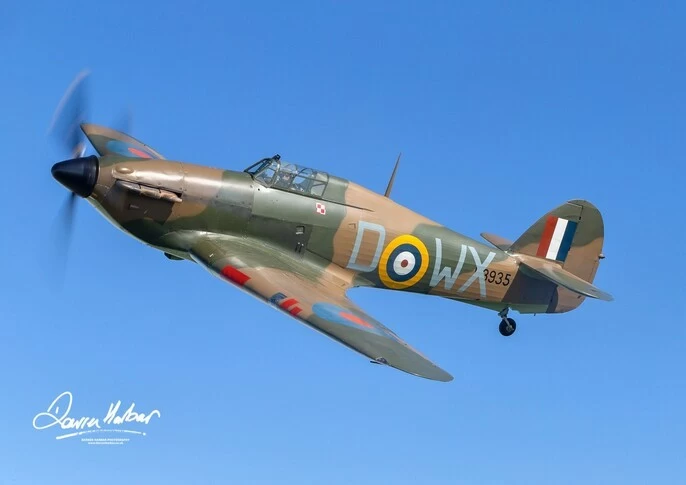
The Hawker Hurricane is a British single seat fighter designed by Hawker Aircraft under Sydney Camm. It first flew on 6 November 1935 and entered production in 1937, with wartime production continuing into 1944 across Hawker, Gloster, Austin and Canadian lines. Although often compared with the Supermarine Spitfire, the Hawker Hurricane is a distinct design, built around a strong tubular metal and fabric covered structure that made it comparatively straightforward to repair in service. Its significance is substantial: the type carried much of the Royal Air Force fighter burden during the Battle of Britain and later served as a fighter bomber, night fighter, naval fighter and ground attack aircraft.
Performance & specifications
Performance varies by mark, engine fit and restoration standard. A representative Hurricane Mk I with a Rolls Royce Merlin II or Merlin III V12 of about 1,030 hp had a maximum speed of approximately 316 mph, about 275 knots, and a service ceiling of about 36,000 feet. Published range for early marks is commonly around 410 nautical miles on internal fuel. Typical loaded weight for a Mk I was about 6,600 lb, with empty weight around 4,670 lb, giving a useful load in the region of 1,900 lb before accounting for modern equipment and restoration differences. Later Hurricane Mk II aircraft used more powerful Merlin XX engines and carried heavier armament or external stores, which affects performance and handling.
Cabin & avionics
The Hawker Hurricane has a compact single seat cockpit rather than a cabin. Visibility, ergonomics and ventilation reflect 1930s military design, with a tailwheel stance, manual systems and high pilot workload compared with modern aircraft. Original instrumentation was entirely analog, with wartime radio and gunsight equipment dependent on role and period. Surviving airworthy examples usually retain a period style panel while adding discreet modern equipment for legal and operational use, such as VHF communications, transponder, altitude encoder, intercom provisions and sometimes portable or panel mounted GPS. Integrated glass suites such as Garmin Perspective or Garmin G1000 are not typical or appropriate for this type.
Buying & value
The Hawker Hurricane occupies a specialist collector and warbird segment rather than the conventional used aircraft market. Buyers should focus on identity, provenance, completeness of records, restoration standard, conformity to an approved configuration, and the depth of technical support for the Merlin engine, propeller, cooling system, landing gear and fabric covered structure. Important variants include the Mk I, Mk II, cannon armed Mk IIC, ground attack Mk IID and Mk IV, plus Sea Hurricane naval adaptations. Value is driven by airworthy status, combat or squadron history, originality, restoration pedigree and engine time. Operating costs, insurance, hangar requirements and pilot qualification demands are material factors.